


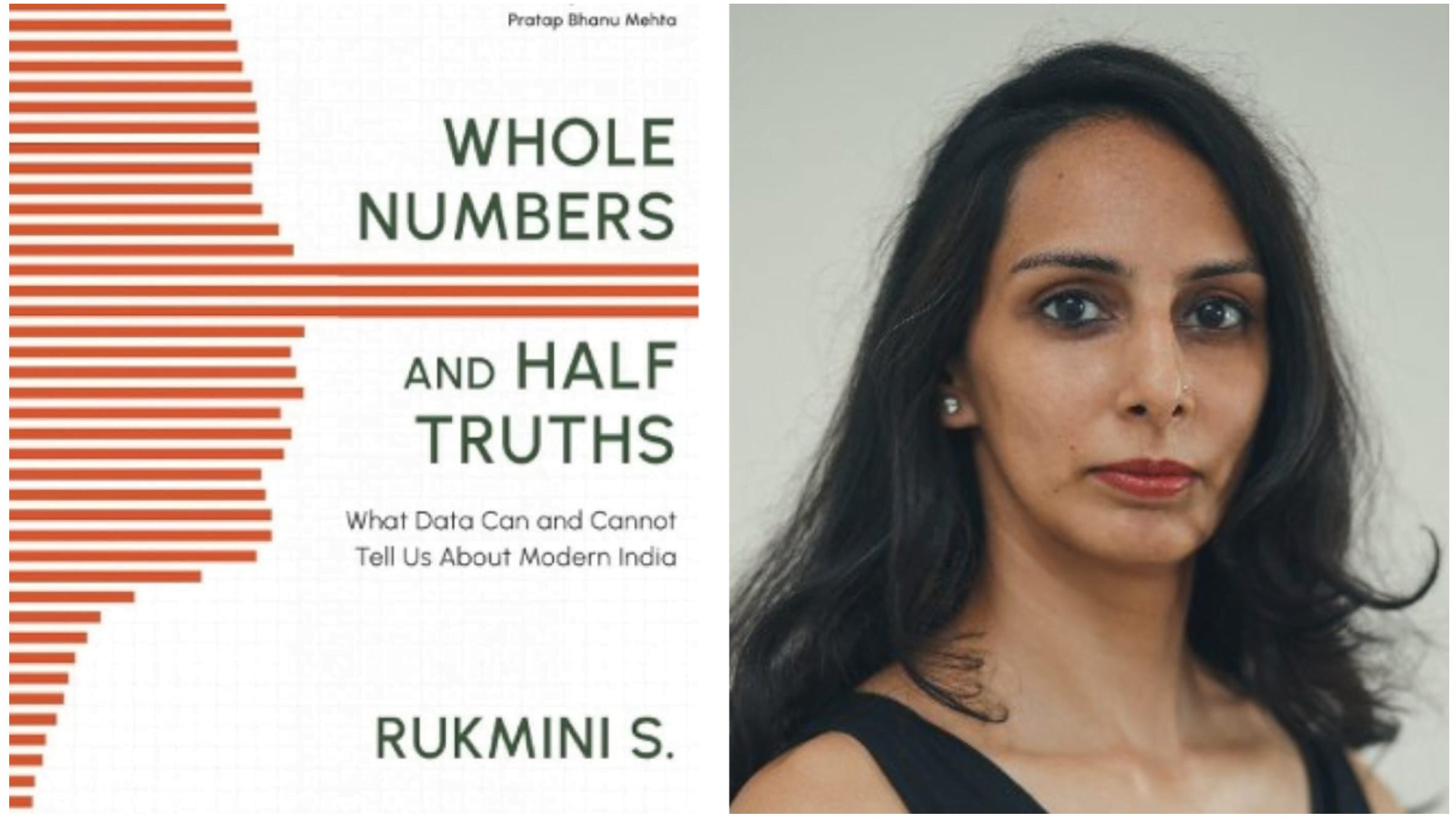
Rukmini S is an independent data journalist based in Chennai, India. She is the author of Whole Numbers and Half Truths and publishes Data for India, crafting data-driven stories. Whole Numbers and Half Truths is an attempt to make sense of Indian life through the substrate of data. It explores private and public dimensions of how India thinks, acts, prays, and even loves—drawing from reliable sources like Lokniti-CSDS, Pew Research, and the Centre for Monitoring the Indian Economy (CMIE) among others.
The Problem with Narratives
The book’s premise is : most established narratives about India are fiction masquerading as fact. Despite having one of the world’s most impressive statistical architectures—Census enumerators, National Statistical Office surveyors, the National Crime Records Bureau—Indians continue to build inaccurate narratives about how the country works. They assume vote-banks where none exist, imagine urban explosions with little reason, and decide they are middle class with little basis. These narratives, repeated enough times, become political fodder.
Numbers, she argues, can capture the nuance and humanity that pre-packaged narratives flatten out.
Belief in God, Marriage & Love
It’s claimed 97% of Indians believe in God, with Buddhists as the notable exception. Buddhist traditions do not promote belief in a creator god, focusing instead on ethical conduct and discipline to attain nirvana—the cessation of suffering. While rituals exist in many Buddhist schools, they are not central to liberation. Religion remains important to Indians: 60% say they pray daily. Education level doesn’t affect religious practice. Indians are largely indifferent to, and tolerant of, the religious practices of others.
The book examines patterns in vegetarian vs. non-vegetarian food consumption, and how food habits intersect with upward mobility. It shows that modern India remains largely conservative—more orthodox in religious practice. It explores dietary choices, alcohol consumption, and the types of alcohol preferred. Foods like poultry, eggs, fish, fruits, and legumes—often more expensive—reveal distinct consumption patterns across income groups.
Indians overwhelmingly marry within their caste. The average age gap between husband and wife is around five years. The poorest 40% of women tend to marry before 18. Richer, better-educated women marry later. Over 90% of marriages in India are arranged by families. Love marriages are more common among richer, better-educated people, and among Christians and Muslims.
Work, Money & Leisure
The book explores how Indians earn, how much they earn, and how they spend on leisure. Enjoyment varies by caste, class, gender, and geography. Most women still aren’t paid for household labor. Nearly 40% of Scheduled Castes work as wage laborers—mostly in casual roles.
Riding motorbikes and singing chants are favourite leisure activities. Rich and upper-caste groups spend more time on religious practice and have more access to media. Inter-religious marriages are seen as acts of rebellion.
Fewer than 20% of women have their names on house papers; half have a bank account in their name; only 10% can make primary purchase decisions. For women working all day, talking to someone is the most meaningful leisure—because no one listens to them.
Crime Statistics: A Cautionary Tale
One of the book’s most striking revelations concerns crime data. Rukmini’s investigation of 600 rape cases in Delhi’s district courts revealed that a significant portion were not sexual assaults as commonly understood, but cases of consenting couples whose families had filed complaints to thwart inter-caste or inter-religious relationships. The FIRs followed informal scripts—”moving cars” that abducted young women, “sedative-laced cold drinks” that rendered victims unconscious. None of it stood up in court. The cold drink bottle was the smoking gun that never appeared.
This isn’t unique to sexual crime. Her investigation of Mumbai’s mephedrone cases found that police knowingly used wrong sections of law to arrest pedlars. The result: 100% acquittal rate, with nearly 150 young people spending over a year in jail on charges the police knew were legally unsound.
The takeaway: India’s crime statistics begin from a point of significant under-reporting, and states with higher reported crime might actually be doing a better job of ensuring full reporting rather than being the most unsafe.
Human Rights, Media & Voting Preferences
There are inferences that media exposure benefits the ruling BJP more than Congress, which performs better among those with low media access. Half of Indians vote based on caste. Many are open to strong leaders and tolerate media bias, discrimination, and segregation based on caste and religion.
Human rights and freedom of expression aren’t widely prioritized. From fans to cult followers, the idea of a fair judiciary or honest elections ranks low. Yet 70% still trust their state government. Media continues to reinforce bias. Among urban graduates and postgraduates, 66.6% lean toward ethnic nationalism and majoritarian views. Ghettoisation of minorities—especially Muslims—is rampant, from physical segregation to anti-Muslim rhetoric in mass media.
Voter turnout is around two-thirds, with more women voting than ever. The surge in female voters reflects growing participation. Ironically, the poor vote because it’s their right, while the non-poor vote for material benefits or out of a sense of duty.
Indians are on the move—especially from states like UP, Bihar, and Bengal. Migrants often can’t vote. In 2015, Janagraha, a Bangalore-based trust working in the areas of urban infrastructure and citizenship, reported that 11% of voter addresses couldn’t be found, 21% had moved, and nearly 50% couldn’t find their names on Delhi’s voter list. Pollsters and journalists often frame voting as driven by caste, religion, leaders, or development—but the reality is more nuanced. After the CAA protests, Muslims voted for AAP (not Congress), even though Congress supported the agitation—because AAP was more likely to defeat BJP. Notably, BJP has no elected Muslim representative.
The Data Imperative
The book’s conclusion carries urgency. Indian official statistics are not lying to us, Rukmini argues, but they are being silenced. A combination of neglect, discredit, and dismissal makes deficiencies seem too fatal to fix. When inconvenient data is suppressed, the narrative shipped to op-ed pages is that official statistics miss too much, so we’re better off without them.
This is dangerous. For 75 years, this data has shaped policy and driven change—debates about liberalisation, poverty lines, welfare states, affirmative action, rising Islamophobia. Access to this data has empowered ordinary citizens to engage with and agitate against the State. Without it, we hollow out democracy.
Final Thoughts
First published in 2021, the datasets referred in some cases may appear dated requiring an update, however the book is an interesting read for those who are curious about modern India—and essential for anyone who wants to engage critically with the narratives we’re fed.